VeloxAI: the multi-model control plane for product teams
Why product teams need one API for models, agents, RAG, billing, analytics, and readiness instead of another thin provider proxy.

Every product team building with AI eventually hits the same wall. It usually happens around week six. The demo works beautifully — Claude Sonnet behind a clean chat UI, streaming responses, users are happy. Then someone asks: can we add document search? Can we switch to a cheaper model for simple questions? Can we see how much each customer is costing us? Suddenly the single-provider SDK that saved you two weeks of integration time is now costing you months of re-architecture.
The proxy trap
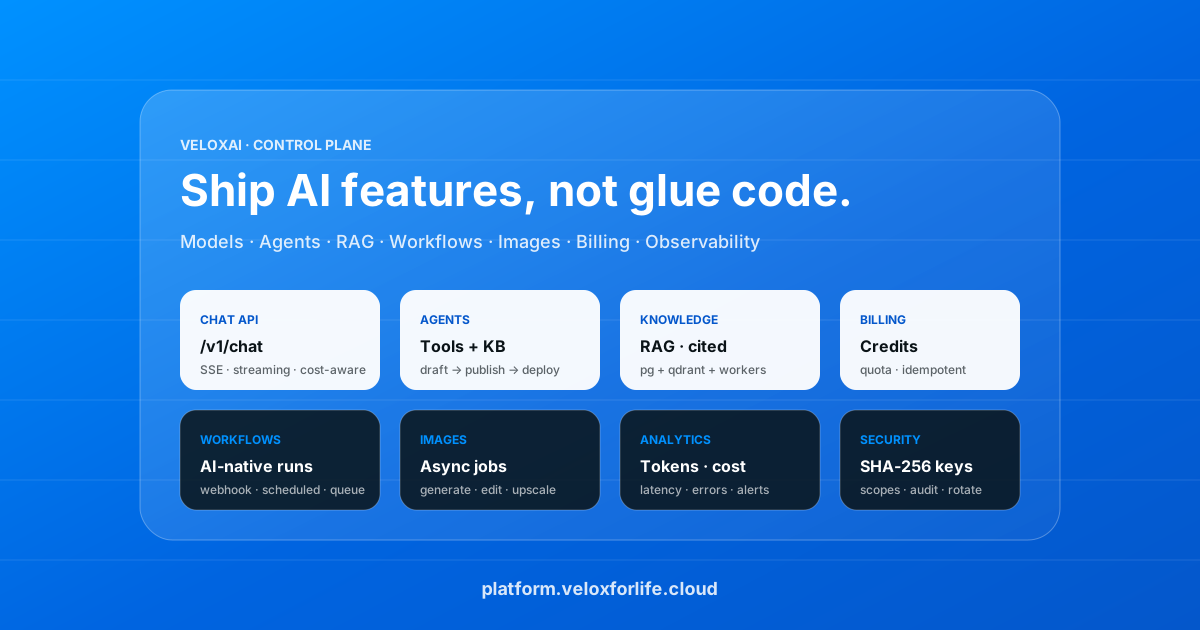
Most multi-model APIs are thin proxies. They accept an OpenAI-format request, forward it to a configured provider, and return the response. That solves exactly one problem: not having to install multiple SDKs. It solves zero of the problems that actually matter in production — authentication across teams, rate limiting per customer, cost tracking per workflow, audit logs, billing integration, cache-aware routing, RAG with citations, agent tool sandboxing, webhook delivery, readiness reporting, and model failover.
A proxy hides complexity behind a friendly interface. A control plane makes complexity visible, auditable, and controllable. VeloxAI is the latter.
What a control plane actually does
- Authenticate API keys with live/test modes under /v1, staying OpenAI-compatible where it matters so existing SDK adapters work without rewrites.
- Check rate limits, quota, plan entitlements, and organization membership before a single token is sent to a provider.
- Route requests to the appropriate model based on real provider readiness — not a hardcoded availability table that lies.
- Stream SSE responses with the OpenAI data: [DONE] contract, recording every token, latency sample, provider identity, and cost before the stream ends.
- Emit usage events to a queue so workers can deduct credits, trigger alerts, update dashboards, and deliver webhooks without blocking the request path.
- Expose analytics filters so operators can zoom from monthly spend down to a single latency spike by model, provider, API key, and endpoint.
- Keep RAG vectors in Qdrant and metadata in PostgreSQL so every answer can cite its source and every retrieval failure is visible.
- Gate custom code tool execution behind a sandbox with CPU, memory, time, network, and filesystem limits instead of running arbitrary code in the request worker.
The real cost of not having one
I have talked to teams that spent three months building internal billing, alerting, model routing, and key management before they could ship their actual product. Three months of platform work for zero customer-facing features. That is the hidden tax of direct provider integration.
async function routeToModel(input: string, custId: string) {
  // 10-step nightmare every team eventually writes:
  // 1. Look up customer plan
  // 2. Check usage vs quota
  // 3. Pick provider by availability
  // 4. Load provider credentials
  // 5. Call provider SDK
  // 6. Parse streaming response
  // 7. Write usage event
  // 8. Update credit balance
  // 9. Check alert thresholds
  // 10. Return response
  // All blocking. None versioned. Works with 1 provider.
}

// VeloxAI: one call, all handled.
const stream = await client.chat.completions.create({
  model: "gpt-4o-mini", stream: true,
  messages: [{ role: "user", content: input }]
});Frequently asked questions
Is VeloxAI just another OpenAI proxy?
No. A proxy forwards requests. VeloxAI authenticates keys, checks quota, routes across providers by real readiness, records usage events to a queue, triggers billing side effects, drives analytics, powers RAG with citations, and gates custom code tools behind sandbox limits. A proxy can't do any of that.
Can I still use the OpenAI SDK?
Yes. Set baseURL to https://platform.veloxforlife.cloud/v1 and use your VeloxAI API key. All chat completions, streaming, and tool calling work through the standard OpenAI client — but with multi-model routing, usage tracking, and quota controls behind the scenes.
What if a provider is down?
VeloxAI checks provider readiness on every request. If a provider returns errors or is marked degraded, the API returns a typed error explaining which dependency is unavailable — no silent fallbacks, no fake success. Your code can catch it and retry with a different model.
Updated:
Ready to ship your AI product?
Start free, route across providers, and see honest cost + readiness from day one.
Related reading
- Models
How to choose the right AI model for every product workflow
A battle-tested model selection framework covering cost, latency, context window, tool calling, vision, and reasoning — with real numbers and a decision matrix.
- Knowledge Base
Building a production RAG system that doesn't lie to users
A production-grade RAG pipeline needs ingestion state, chunk metadata, vector isolation, citations, queue-based indexing, and honest failure modes.
- Agent Security
Agent tools are powerful. That's exactly why they need sandboxes.
Useful agents call tools. Safe agents validate tool schemas, isolate execution, cap runtime, block network egress, and log every call.