The AI billing pipeline: from token to invoice
Production AI billing needs usage events, idempotent payments, credit accounting, per-model cost breakdowns, and proactive balance alerts.

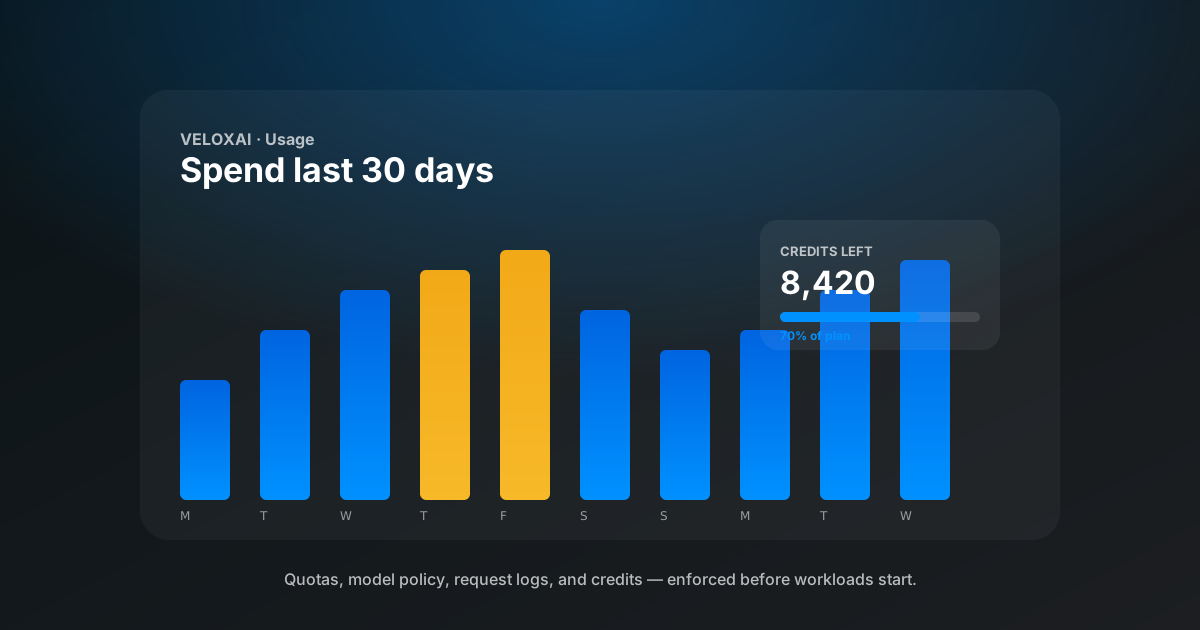
AI billing is fundamentally different from SaaS billing. In SaaS you charge per seat per month. In AI, every request has a different cost — different model, different token count, different provider pricing, different cache hit rates. Your billing pipeline must capture this granularity or you will either undercharge (losing money) or overcharge (losing customers).
Usage events are source of truth
// Emit after every API response — never write synchronously
interface UsageEvent {
  requestId: string;  orgId: string;  apiKeyId: string;
  model: string;  provider: string;
  inputTokens: number;  outputTokens: number;
  cacheReadTokens: number;  latencyMs: number;
  status: 'success' | 'error';
  costUsd: number;  creditCost: number;
}

// Process in queue worker:
await Promise.all([
  deductCredits(event.orgId, event.creditCost),
  writeAnalyticsEvent(event),
  checkAlertThresholds(event.orgId)
]);Idempotent credit deduction
Use the request ID as the idempotency key. If a usage event is processed twice (queue retry, worker crash), the same credit must not be deducted twice. Payment callbacks must also be idempotent — verify with the provider before updating balances.
Analytics as a query layer
Users must filter spend by date range, model, provider, API key, and status. Show latency percentiles (p50, p95, p99), error rates, and cache hit rates. Operators must drill from a monthly spike to the exact request that caused it.
Updated:
Ready to ship your AI product?
Start free, route across providers, and see honest cost + readiness from day one.
Related reading
- Cost
The AI cost optimization playbook: 7 tactics that actually work
Practical cost reduction: tiered routing, prompt caching, output constraints, batch processing, usage alerts, and cache-aware architecture.
- Product
VeloxAI: the multi-model control plane for product teams
Why product teams need one API for models, agents, RAG, billing, analytics, and readiness instead of another thin provider proxy.
- Models
How to choose the right AI model for every product workflow
A battle-tested model selection framework covering cost, latency, context window, tool calling, vision, and reasoning — with real numbers and a decision matrix.